

A group of nonprofit employees reviewing data from the Needs Assessment in BHACF's office.
The information below is Black Hills Area Community Foundation’s summary of the Food Security Needs Assessment of Rapid City conducted by Augustana Research Institute.
The Food Security Needs Assessment of Rapid City, conducted in 2024 by Augustana Research Institute, identifies key barriers to food access in Rapid City and recommendations for the community. BHACF commissioned the report to provide actionable data to the community and guide the Community Foundation’s investments in the space.
The research, which combines focus group data with a map analysis, was performed by Suzanne Smith, Ph.D, associate vice president for enterprise data analytics and ARI. The focus groups learned from 91 community members representing eight populations, including older adults, college students, guardians and parents, residents facing housing insecurity, Indigenous residents, nonprofit providers, youth, and veterans.
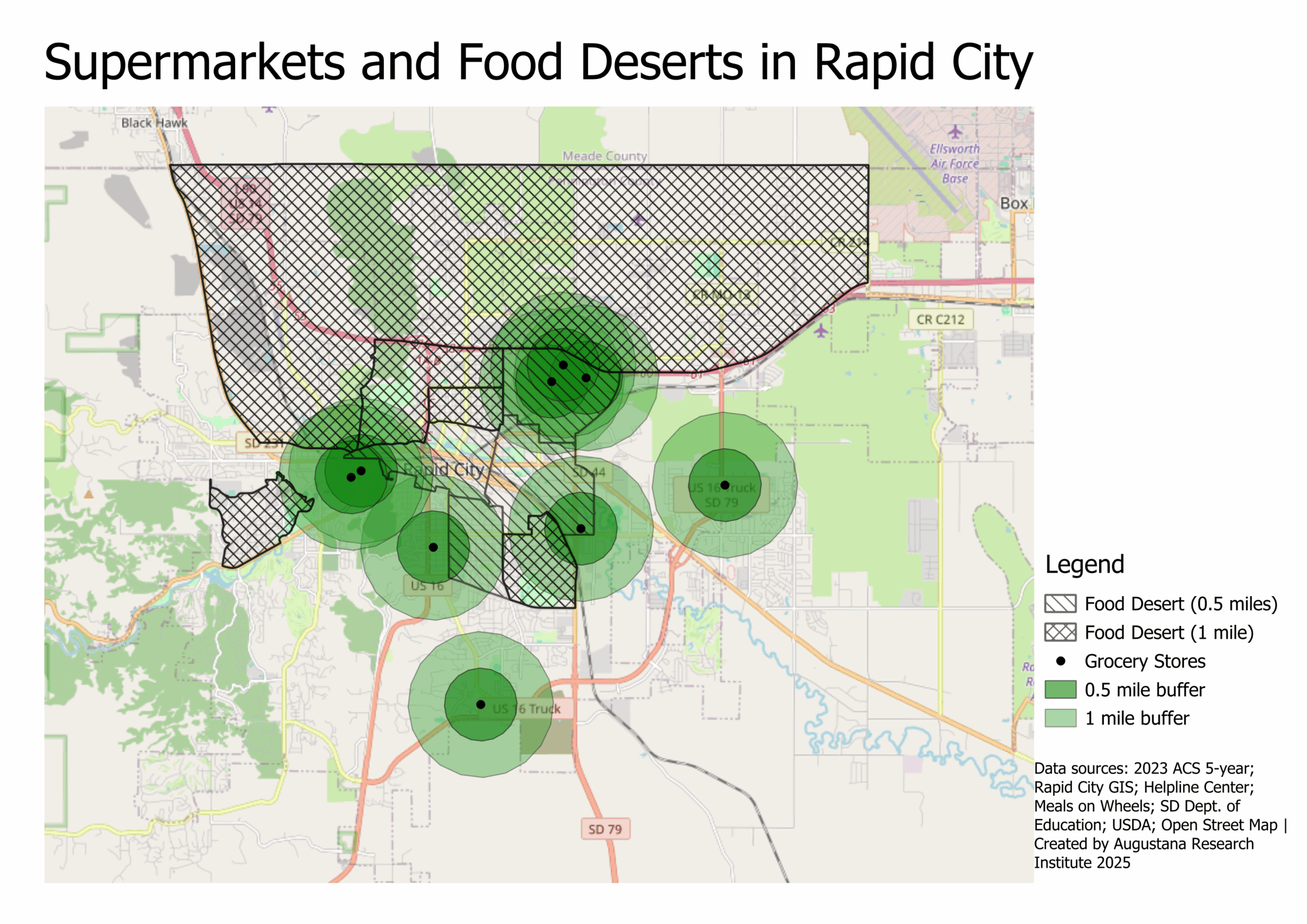
An estimated 33,702 Rapid City residents live in food desert census tracts, or areas with both low incomes and low access to supermarkets. Neighborhoods between North Street and I-90 are flagged as the areas of highest concern where an estimated 75% of the population lives at least a mile from a supermarket.
Residents in these areas face significantly higher poverty rates (27-33%) and a higher proportion of the households rely on SNAP benefits. There is a concentration of Helpline Center calls for support in these neighborhoods and a lack of charitable resources available after 5 p.m. or on weekends.
As a whole, food desert census tracts in Rapid City house a disproportionate number of Indigenous residents and residents in poverty compared to citywide averages.
Most charitable food pantries are open during conventional working hours in Rapid City. This means that some people who work jobs (or those who rely on people with jobs for transportation) face significant logistical challenges accessing support. About 70% of Rapid City families receiving SNAP have at least one person working a job, according to the most recent 2023 census estimate.
“What we need to work on the most is more locations and more timing correctly because sometimes we all don’t work on the same work schedule. Some people can’t get to the same area before the time is out.”
YOUNG PERSON IN rapid city
Challenges with transportation also pose a sigificant barrier to food access. “The logistics of getting food can be overwhelming” for residents without a vehicle or people living paycheck to paycheck, the study explains. In the area between Anamosa Street and I-90—one of the city’s most food-insecure areas—approximately one in five households lack access to a vehicle.
While food desert areas are served by Rapid Transit, residents said they have trouble accomodating limited bus schedules and routes. Rapid Transit services end at 5:50 p.m. on weekdays, just when many residents are completing their work day. “Focus group participants shared that they sometimes must choose between affordability and accessibility, unable to reach lower-cost retailers due to lack of transportation,” the study explains.
“Acquiring food, it’s pretty bad because it usually takes about half a day. For food, kind of cuts into your time. It has to be the working day, the bus starts at six, they end at six. But the places you gotta go start at nine and they close at four, that’s your window. [It takes] all afternoon.”
RAPID CITY VETERAN
When residents can’t meet their needs at a retailer, charitable resources are a vital lifeline. However, residents described challenges when receiving unfamiliar foods or foods that don’t comprise a meal. Specifically, focus groups revealed a lack of protein, baby formula, produce, culturally relevant ingredients, kitchen staples, and medically tailored foods in their diet.
Beyond providing food, many providers connect residents to other stabilizing local resources. Several residents said they made the most progress toward self sufficiency when connected with a case manager. Both providers and residents described a need for more case management and wrap-around services to help residents navigate logistical challenges and the various means of accessing support in Rapid City.
Stigma prevents many residents from looking for help. Some felt they were not deserving of resources, while some weren’t comfortable with the interpersonal interactions required to get support. As one older adult said, “just embarrassment, I guess, is the biggest thing. It’s having to go like that, get help. And, I’m not a person that likes to ask people for help much, I mean, I’d rather struggle sometimes than ask for help.”
Residents Report Making Difficult Tradeoffs
Focus groups revealed that residents are making difficult financial tradeoffs. Community members described choosing between paying for shelter and food, or going without food to provide for the children in their care.
A mother in a focus group described choosing shelter over having enough food for her children. “When it literally came down to like just having that apartment but no food…I felt really bad about putting my kids in that. So, I mean, it came down to them being provided for and them being safe,” she said.
Residents also described prioritizing tuition, gas, and medical costs over having enough food. As one college student explained, “There are days where I’ll eat one meal a day because my payment for school is coming up, so, it’s like, I gotta stretch my money.”
“There was a time where I had to choose between feeding my child and they were on formula. So, it was either child gets fed and I don’t, or they don’t get fed, things like that. So, I had to, like, create a method where I got one Little Caesars pizza per week, and that was my lunch and dinner, and then my baby would get formula for that week. You know, that’s the sacrifices we have to make.”
RAPID CITY MOTHER
“There are days where I’ll eat one meal a day because my payment for school is coming up, so it’s like, I gotta stretch my money.”
Rapid City college student
Upcoming Investment in Food Security
The food landscape in Rapid City continues to change since 2024. In 2025, nonprofits have reported increased demand due to ripple effects from economic uncertainty and decreasing federal support for food programs.
Rapid City nonprofit leaders who are navigating challenges due to federal funding cuts should reach out directly to Foundation staff for information about bridge funding to sustain or pivot their services. BHACF will also invest $100,000 in food security grants to address gaps informed by the study in 2026.
Community members who are interested in learning more about the issue can reach out directly to Foundation staff.